Cart summary

You have no items in your shopping cart.

Y-27632 dihydrochloride

SKU: orb1307611

Description

Y-27632 dihydrochloride is a potent, cell-permeable inhibitor targeting ROCK-I and ROCK-II kinases. It is widely used in vitro to study cytoskeletal dynamics and cell adhesion, and in vivo to investigate pathways in neuroprotection, cardiovascular function, and stem cell survival.

Research Area

Cell Biology, Signal Transduction, Stem Cell & Developmental Biology

Customer Validated Data

The data below is submitted by researchers worldwide. We provide this transparency to help you decide if this product works for your specific application or species, even if we haven't tested it ourselves.
Success by Application
Reactivity Distribution

Latest Experiments

3 Results
Dilution
Sample
Summary
Organoid culture
Human
10 µM
Human ameloblastoma tissue
It was used at 10 µM...
Cell culture
Porcine
5 µM
Porcine (Sus scrofa) parthenogenetic blastocysts
It was used as a ROCK...
Cell culture
Human
5 µM
Human ESC line H9
It was use as a ROCK...

Images & Validation

Key Properties

CAS Number129830-38-2
MW320.26
Purity99.98% (May vary between batches)
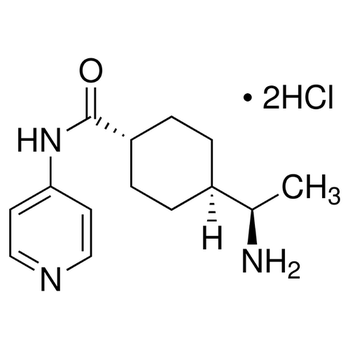
FormulaC14H21N3O·2HCl
SMILESCl.Cl.C[C@@H](N)[C@H]1CC[C@@H](CC1)C(=O)Nc1ccncc1
TargetROCK,Apoptosis
SolubilityH2O:32.03 mg/mL (100.01 mM);10% DMSO+40% PEG300+5% Tween 80+45% Saline:5 mg/mL (15.61 mM);DMSO:255 mg/mL (796.23 mM)

Bioactivity

Target IC50
Citron kinase:5.3 μM (Ki)|ROCK1 (p160ROCK):140 nM (Ki, cell free)|PKN:3.1 μM (Ki)|ROCK2:300 nM (Ki, cell free)|PKCα:73 μM (Ki)|PKA:25 μM (Ki)|CITK:5.3 μM (Ki)|ROCK1:220 nM (Ki)
In Vivo
METHODS: To investigate the therapeutic potential of Y-27632 in motor neuron disease, Y-27632 (2 or 30 mg/kg in drinking water) was administered orally to SOD1G93A mice in the ALS model for 137 days. RESULTS: Y-27632 2 mg/kg treatment was ineffective, Y-27632 30 mg/kg treatment improved motor function in male mice, and female mice showed only limited improvement. METHODS: To investigate the effect of Y-27632 on liver fibrosis, Y-27632 (30 mg/kg) was administered orally to rats with dimethylnitrosamine (DMN)-induced liver fibrosis once a day for four weeks. RESULTS: Y-27632 treatment significantly reduced the incidence of DMN-induced hepatic fibrosis and lowered the levels of collagen and hydroxyproline as well as the expression of α-SMA in the liver.
In Vitro
METHODS: Human induced pluripotent stem cells, marmoset iPSC, were treated with Y-27632 (5-20 μM) for 7 days and clone formation was detected by AKP. RESULTS: Y-27632 significantly improved the cloning efficiency of marmoset iPSC. METHODS: Adult adipose tissue-derived stem cells ADSCs were treated with Y-27632 (5 μmol/L) for 1 h. The morphological changes of ADSCs were detected. RESULTS: Y-27632 dose-dependently induced neuronal differentiation in ADSCs. the percentage of neuron-like cells in ADSCs treated with 5 μmol/L Y-27632 for 1 h was (93.5±4.7)%. METHODS: Crab monkey embryonic stem cells cyES were routinely passaged or treated with Y-27632 (1-10 μM) for 24 h. Live-dead staining was performed using the Flow Cytometry method, and BrdU was detected using a kit. RESULTS: Y-27632 promoted the increase of cyES surviving cells. Y-27632 did not promote cell proliferation, but protected the cells from cell death after single-cell digestion.
Cell Research
HeLa cells are plated at a density of 3×10^4 cells per 3.5-cm dish. The cells are cultured in DMEM containing 10% FBS in the presence of 10 mM Thymidine for 16 h. After the cells are washed with DMEM containing 10% FBS, they are cultured for an additional 8 h, and then 40 ng/mL of Nocodazole is added. After 11.5 h of the Nocodazole treatment, various concentrations of Y-27632 (0-300 μM) or vehicle is added and the cells are incubated for another 30 min .
Animal Research
A group of animals was injected with a single dose of pentylenetetrazole (PTZ, 65 mg/kg) to investigate if the two Rho-kinase inhibitors, fasudil, and Y-27632, changed the onset of PTZ seizures. Fasudil, Y-27632 or saline was given intraperitoneally 30 min before the PTZ injection. Each mouse was then observed for a 15-min period to measure the onset of the first myoclonic jerk, the onset of the first clonic convulsion and the occurrence of tonic hindlimb extension. Some of the animals died after tonic hindlimb extension, which is an expected outcome of acute PTZ injection. After the observation period, all animals were killed by halothane anesthesia . Seven-week-old male Wistar rats were anesthetized with sodium pentobarbital. A silver clip (0.2 mm in diameter) was placed on the left renal artery in the preparation of the renal hypertensive rats. In the preparation of the DOCA-salt hypertensive rats, the left kidney was removed and a DOCA pellet (50 mg) was implanted subcutaneously. The DOCA rats were then fed an 8% salt diet. Rats from both groups were used after 8 weeks in the experiments, together with a male, 17–22-week old spontaneously hypertensive rats. The average systolic pressure in these groups of hypertensive rats ranged from 209 to 237 mm Hg, and no significant difference was found between groups. Eight-week-old male Wistar rats were used as controls. Their average systolic pressure was 139 mm Hg. Y-27632was administered orally. The systolic blood pressure was measured by the tail cuff method at 1, 3, 5, 7 and 24 h. The rats were prewarmed to 40 8C for 10 min before each measurement. No toxicity was found in rats treated with 30 mg kg 1 of Y-27632 administered per os once per day for 10 days .

Storage & Handling

Storagekeep away from moisture,keep away from direct sunlight,store at low temperature | Powder: -20°C for 3 years | In solvent: -80°C for 1 year | Shipping with blue ice/Shipping at ambient temperature.
Expiration Date12 months from date of receipt.
DisclaimerFor research use only

Alternative Names

epithelial-mesenchymal, hIPSCs, Inhibitor, inhibit, lineage, mesendodermal, orally, pluripotent, modulation, Apoptosis, ATP-competitive, active, cells, Y27632, Y-27632, Y-27632 2HCl, Y27632 Dihydrochloride, Y27632 dihydrochloride, Y-27632 Dihydrochloride, Y 27632, Y 27632 Dihydrochloride, Y 27632 dihydrochloride, Rho-kinase, ROCK1 (p160ROCK), ROCK2, ROCK, ROK, Rho-associated protein kinase, Rho-associated kinase, transition-like, stem

Similar Products

  • Y-33075 dihydrochloride [orb1219732]

    >98% (HPLC)

    173897-44-4

    353.3

    C16H18Cl2N4O

    25 mg, 2 mg, 10 mg, 1 g, 500 mg, 200 mg, 5 mg, 50 mg, 100 mg
  • Y-27632 dihydrochloride [orb1226595]

    >98%(HPLC)

    129830-38-2

    320.3

    C14H21N3O·2HCl

    1 g, 500 mg, 5 mg, 10 mg, 25 mg, 50 mg, 200 mg, 100 mg
Quality Guarantee

Quality Guarantee

Explore bioreagents carefree to elevate your research. All our products are rigorously tested for performance. If a product does not perform as described on its datasheet, our scientific support team will provide expert troubleshooting, a prompt replacement, or a refund. For full details, please see our Terms & Conditions and Buying Guide. Contact us at support@biorbyt.com.

Key Properties

No computed properties available.

Documents Download

Datasheet
Product Information
Download

Request a Document

Protocol Information

Y-27632 dihydrochloride (orb1307611)

  • Star
  • Star
  • Star
  • Star
  • Star
  • 0.0
Based on 0 reviews

Participating in our Biorbyt product reviews program enables you to support fellow scientists by sharing your firsthand experience with our products.

Login to Submit a Review

No reviews yet

Step 1: Enter information below

(Recommended: An additional animal making an allowance for loss during the experiment)

Step 2: Enter the in vivo formulation

(This is only the calculator, not formulation. Please contact us first if there is no in vivo formulation at the solubility Section.)

% DMSO +
%+
% Tween 80 +
%

Available Sizes

Select a size below

1 ml x 10 mM (in DMSO)
$ 80.00
5 mg
$ 80.00
10 mg
$ 90.00
25 mg
$ 130.00
50 mg
$ 190.00
100 mg
$ 290.00
DispatchUsually dispatched within 3-5 working days
Bulk Enquiry