Cart summary

You have no items in your shopping cart.

Cav3.2 Antibody (APC)

SKU: orb148211
FeaturedFeatured Product

Description

Mouse monoclonal to CaV3 (APC). 2. Ion channels are integral membrane proteins that help establish and control the small voltage gradient across the plasma membrane of living cells by allowing the flow of ions down their electrochemical gradient. They are present in the membranes that surround all biological cells because their main function is to regulate the flow of ions across this membrane. Whereas some ion channels permit the passage of ions based on charge, others conduct based on a ionic species, such as sodium or potassium. Furthermore, in some ion channels, the passage is governed by a gate which is controlled by chemical or electrical signals, temperature, or mechanical forces. There are a few main classifications of gated ion channels. There are voltage- gated ion channels, ligand-gated, other gating systems and finally those that are classified differently, having more exotic characteristics. The first are voltage- gated ion channels which open and close in response to membrane potential. These are then separated into sodium, calcium, potassium, proton, transient receptor, and cyclic nucleotide-gated channels; each of which is responsible for a unique role. Ligand-gated ion channels are also known as ionotropic receptors, and they open in response to specific ligand molecules binding to the extracellular domain of the receptor protein. The other gated classifications include activation and inactivation by second messengers, inward-rectifier potassium channels, calcium-activated potassium channels, two-pore-domain potassium channels, light-gated channels, mechano-sensitive ion channels and cyclic nucleotide-gated channels. Finally, the other classifications are based on less normal characteristics such as two-pore channels, and transient receptor potential channels. Specifically, CaV3. 2 is a protein which in humans is encoded by the CACNA1H gene. Studies suggest certain mutations in this gene lead to childhood absence epilepsy. Studies also suggest that the up-regulations of CaV3. 2 may participate in the progression of prostate cancer toward an androgen-independent stage. ...

Images & Validation

Tested ApplicationsAM, ICC, IF, IHC, IP, WB
Dilution rangeWB (1:1000), IHC (1:1000), ICC/IF (1:100)
ReactivityHuman, Mouse, Rat
Application Notes
1 µg/ml of SMC-303 was sufficient for detection of Cav3.2 in 10 µg of HEK cell lysate expressing Cav3.2 by colorimetric immunoblot analysis using Goat anti-mouse IgG:HRP as the secondary antibody.

Key Properties

HostMouse
ClonalityMonoclonal
IsotypeIgG1
Clone No.N55/10 (Formerly sold as S55-10)
ImmunogenFusion protein amino acids 1019-1293 (II-III loop) of human Cav3.2
TargetCav3.2
Molecular Weight260kDa
PurificationProtein G Purified
ConjugationAPC

Storage & Handling

StorageConjugated antibodies should be stored according to the product label
Buffer/Preservatives95.46mM Phosphate, 2.48mM MES and 2mM EDTA
Concentration1 mg/ml
DisclaimerFor research use only

Alternative Names

Voltage-dependent T-type calcium channel subunit alpha-1H, Voltage-gated calcium channel subunit alpha Cav3.2, CACNA1H, KIAA1120, Cav3.2, CACNA1HB, calcium channel, voltage-dependent, T type, alpha 1H subunit, alpha 1Hb subunit, ECA6, EIG6, FLJ90484, Low-voltage-activated calcium channel alpha1 3.2 subunit, low-voltage-activated calcium channel alpha13.2 subunit, voltage dependent t-type calcium channel alpha-1H subunit, voltage-dependent T-type calcium channel subunit alpha-1H, voltage-gated calcium channel alpha subunit Cav3.2, voltage-gated calcium channel alpha subunit CavT.2

Similar Products

Quality Guarantee

Quality Guarantee

Explore bioreagents carefree to elevate your research. All our products are rigorously tested for performance. If a product does not perform as described on its datasheet, our scientific support team will provide expert troubleshooting, a prompt replacement, or a refund. For full details, please see our Terms & Conditions and Buying Guide. Contact us at support@biorbyt.com.

Cav3.2 Antibody (APC)

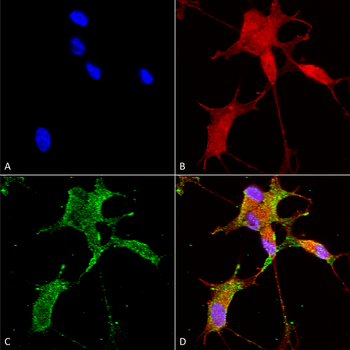
Immunocytochemistry/Immunofluorescence analysis using Mouse Anti-Cav3.2 Monoclonal Antibody, Clone N55/10. Tissue: Neuroblastoma cells (SH-SY5Y). Species: Human. Fixation: 4% PFA for 15 min. Primary Antibody: Mouse Anti-Cav3.2 Monoclonal Antibody at 1:50 for overnight at 4°C with slow rocking. Secondary Antibody: AlexaFluor 488 at 1:1000 for 1 hour at RT. Counterstain: Phalloidin-iFluor 647 (red) F-Actin stain; Hoechst (blue) nuclear stain at 1:800, 1.6mM for 20 min at RT. (A) Hoechst (blue) nuclear stain. (B) Phalloidin-iFluor 647 (red) F-Actin stain. (C) Cav3.2 Antibody (D) Composite.

Cav3.2 Antibody (APC)

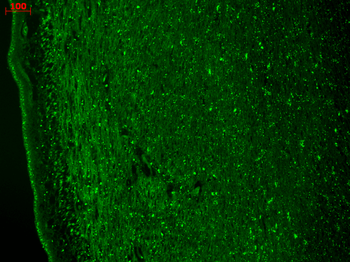
Immunohistochemistry analysis using Mouse Anti-CaV3.2 Calcium Channel Monoclonal Antibody, Clone N55/10. Tissue: hippocampus. Species: Human. Fixation: Bouin's Fixative and paraffin-embedded. Primary Antibody: Mouse Anti-CaV3.2 Calcium Channel Monoclonal Antibody at 1:1000 for 1 hour at RT. Secondary Antibody: FITC Goat Anti-Mouse (green) at 1:50 for 1 hour at RT.

Cav3.2 Antibody (APC)

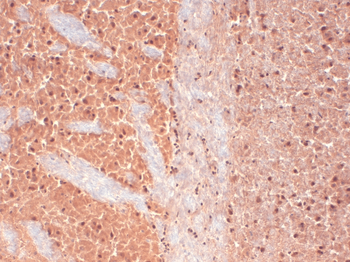
Immunohistochemistry analysis using Mouse Anti-CaV3.2 Calcium channel Monoclonal Antibody, Clone N55/10. Tissue: frozen brain section. Species: Human. Fixation: 10% Formalin Solution for 12-24 hours at RT. Primary Antibody: Mouse Anti-CaV3.2 Calcium channel Monoclonal Antibody at 1:1000 for 1 hour at RT. Secondary Antibody: HRP/DAB Detection System: Biotinylated Goat Anti-Mouse, Streptavidin Peroxidase, DAB Chromogen (brown) for 30 minutes at RT. Counterstain: Mayer Hematoxylin (purple/blue) nuclear stain at 250-500 μl for 5 minutes at RT.

Cav3.2 Antibody (APC)

Western Blot analysis of Rat brain membrane lysate (native) showing detection of ~261 kDa Cav3.2 protein using Mouse Anti-Cav3.2 Monoclonal Antibody, Clone N55/10. Block: 2% Skim Milk + 2% BSA in TBST. Primary Antibody: Mouse Anti-Cav3.2 Monoclonal Antibody at 1:1000 for 2 hours at RT. Secondary Antibody: Anti-Mouse: HRP at 1:4000. Predicted/Observed Size: ~261 kDa.

UniProt Details

No UniProt data available

NCBI Gene Details

No NCBI Gene data available

NCBI Reference Sequences

Associated Accession Numbers
Curated reference sequences for the gene transcript and protein product

Documents Download

Datasheet
Product Information
Download

Request a Document

Protocol Information

WB
Western Blot (IB, immunoblot)
View Protocol
IHC
Immunohistochemistry
View Protocol
IF
Immunofluorescence
View Protocol
ICC
Immunocytochemistry
View Protocol
IP
Immunoprecipitation
View Protocol

Cav3.2 Antibody (APC) (orb148211)

  • Star
  • Star
  • Star
  • Star
  • Star
  • 0.0
Based on 0 reviews

Participating in our Biorbyt product reviews program enables you to support fellow scientists by sharing your firsthand experience with our products.

Login to Submit a Review

No reviews yet

Available Sizes

Select a size below

100 μg
$ 660.00
DispatchUsually dispatched within 2-3 weeks
Bulk Enquiry