You have no items in your shopping cart.
Validated
Description
Images & Validation
−| Tested Applications | HAI, KO/KD Validated |
|---|---|
| Application Notes |
Key Properties
−| Antibody Type | Primary Antibody |
|---|---|
| Host | Rabbit |
| Clonality | Polyclonal |
| Isotype | Antiserum |
| Immunogen | Chicken washed pooled Red Blood Cells (RBC) |
| Purity | This product was prepared from polyspecific antiserum by a delipidation and defibrination. |
| Conjugation | Unconjugated |
Storage & Handling
−| Storage | Store vial at 4° C prior to restoration. For extended storage aliquot contents and freeze at -20° C or below. Avoid cycles of freezing and thawing. Centrifuge product if not completely clear after standing at room temperature. This product is stable for several weeks at 4° C as an undiluted liquid. Dilute only prior to immediate use. |
|---|---|
| Form/Appearance | Lyophilized |
| Buffer/Preservatives | 0.01% (w/v) Sodium Azide |
| Concentration | 60 mg/mL |
| Expiration Date | 12 months from date of receipt. |
| Disclaimer | For research use only |
Alternative Names
−Similar Products
−
Quality Guarantee
Explore bioreagents carefree to elevate your research. All our products are rigorously tested for performance. If a product does not perform as described on its datasheet, our scientific support team will provide expert troubleshooting, a prompt replacement, or a refund. For full details, please see our Terms & Conditions and Buying Guide. Contact us at support@biorbyt.com.

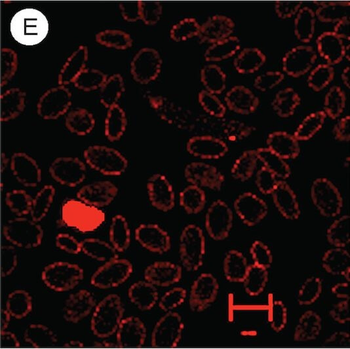
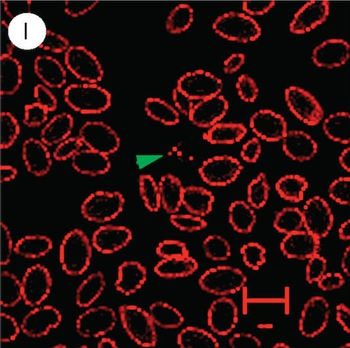
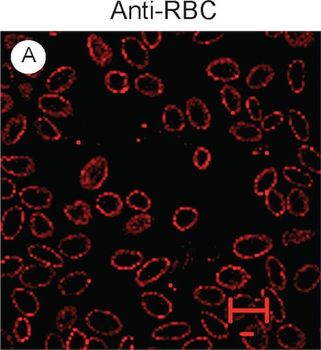
Confocal images of infected chicken blood cells stained with anti-red blood cell antibodies. Anti-RBC, images stained with rabbit anti-chicken red blood cell antibody 103–4139; DIC, differential interference contrast images; Hoechst, Hoechst dye staining of nuclei (DNA); Merged, merged images of anti-RBC, DIC, and DAPI. (A-H) Two cells infected with L. sabrazesi gametocytes have some red dots (yellow arrowheads) that appear to be within the cytoplasm of the host cells. (E-H) A strongly stained white cell (grey arrowheads) that has two nuclei and rough granules in the cytoplasm, suggesting heterophils, monocytes, macrophages, or eosinophils. (I-L) A small cell that has a round nucleus and red dots similar (green arrowheads) to those seen in the infected cells. The small size of the cell suggests that it is likely a thrombocyte. The red ruler in each image indicates 10 µm.

Confocal images of infected chicken blood cells stained with anti-red blood cell antibodies.Anti-RBC, images stained with rabbit anti-chicken red blood cell antibody 103–4139; DIC, differential interference contrast images; Hoechst, Hoechst dye staining of nuclei (DNA); Merged, merged images of anti-RBC, DIC, and DAPI. (A-H) Two cells infected with L. sabrazesi gametocytes have some red dots (yellow arrowheads) that appear to be within the cytoplasm of the host cells. (E-H) A strongly stained white cell (grey arrowheads) that has two nuclei and rough granules in the cytoplasm, suggesting heterophils, monocytes, macrophages, or eosinophils. (I-L) A small cell that has a round nucleus and red dots similar (green arrowheads) to those seen in the infected cells. The small size of the cell suggests that it is likely a thrombocyte. The red ruler in each image indicates 10 µm.

Confocal images of infected chicken blood cells stained with anti-red blood cell antibodies.Anti-RBC, images stained with rabbit anti-chicken red blood cell antibody 103–4139; DIC, differential interference contrast images; Hoechst, Hoechst dye staining of nuclei (DNA); Merged, merged images of anti-RBC, DIC, and DAPI. (A-H) Two cells infected with L. sabrazesi gametocytes have some red dots (yellow arrowheads) that appear to be within the cytoplasm of the host cells. (E-H) A strongly stained white cell (grey arrowheads) that has two nuclei and rough granules in the cytoplasm, suggesting heterophils, monocytes, macrophages, or eosinophils. (I-L) A small cell that has a round nucleus and red dots similar (green arrowheads) to those seen in the infected cells. The small size of the cell suggests that it is likely a thrombocyte. The red ruler in each image indicates 10 µm.

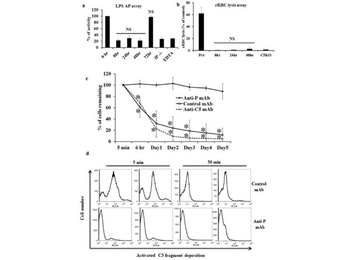
Therapeutic efficacy of anti-human P mAb 19.1 in a murine model of extravascular hemolysisa: Pharmacodynamics of mAb 19.1 in hP transgenic mice. Each mouse was treated with 0.5 mg mAb 19.1 (n = 3 mice). Serum samples were collected before and at various time points after mAb treatment and assessed for LPS-dependent AP complement activity. At this dosage of mAb 19.1, AP complement activity was suppressed to background (P−/−) level for 2 days. EDTA: time 0 sample with EDTA (20 mM) added. NS, non-significant comparing 8, 24 and 48 hr samples with fP−/− or EDTA-treated serum, or comparing 72 hr sample with 0 hr sample. One-way ANOVA. b: Pharmacodynamics of anti-mouse C5 mAb (BB5.1) in hP transgenic mice. Each mouse was treated with 1mg of anti-mouse C5 mAb (n = 3). Serum samples were collected before and at various time points after mAb treatment and assessed for lytic activity using antibody-sensitized chicken RBCs. C5 knockout (KO) mouse serum was used as a control for C5 inhibition. Percentage of chicken RBC (cRBC) lysis was normalized to a sample completely lysed by hypotonic shock in double distilled water. * P < 0.0001, NS: non-significant compared with C5KO serum. One-way ANOVA. c. Effect of anti-hP mAb 19.1 on the survival of transfused CFSC-labeled DAF−/−/Crry−/−/C3−/− mouse erythrocytes in hP- transgenic mice. Recipient mice were treated with anti-hP mAb 19.1 (n = 4) or an isotype control mAb (n = 4) or anti-mouse C5 mAb (n = 3) 6 hours prior to red blood cell transfusion and blood samples were taken at 5 min, 6 hrs and then daily for 5 days. The percentage of CFSC-labeled red blood cells was measured by FACS and normalized to that determined at 5 min (100%). Transfused DAF−/−/Crry−/−/C3−/− mouse red blood cells were rapidly eliminated in control mAb- or anti-C5 mAb-treated hP transgenic mice but such an outcome was prevented by mAb 19.1 treatment. * P < 0.001, Two-way ANOVA. d. FACS analysis of activated C3 fragment deposition on DAF−/−/Crry−/−/C3−/− RBCs 5 and 30 min after their transfusion into control mAb- or mAb 19.1-treated hP-Tg/P−/− mice (representative data from two recipient mice are shown). At both time points, C3 fragment deposition was significantly higher on RBCs transfused into control mAb-treated than mAb 19.1-treated hP-Tg/P−/− mice. The reason for the marked reduction in C3 fragment deposition on RBCs in control mAb-treated hP-Tg/P−/− mice between 5 and 30 min is unknown, but could be caused by C3 fragment degradation to C3d or shedding from the cell surface or rapid removal of the C3-opsonized cells. Data in a-c are presented as mean (SD) with indicated n numbers. Antibody-sensitized chicken RBC (p/n orb1567092) prepared by incubating the cells with a rabbit anti-chicken RBC antibody (p/n orb1568264).
Documents Download
Request a Document
Chicken Red Blood Cell RBC Antibody (orb1568264)
Participating in our Biorbyt product reviews program enables you to support fellow scientists by sharing your firsthand experience with our products.
Login to Submit a Review