
You have no items in your shopping cart.

Assay Fundamentals
ELISA Kits: The Basics
A comprehensive introduction to Enzyme-Linked Immunosorbent Assays, core workflows, and kit selection.
An Enzyme-Linked Immunosorbent Assay (ELISA) is a foundational immunochemical method used to detect and quantify target analytes—such as proteins, antibodies, peptides, and hormones—within complex biological samples.
High Sensitivity & Specificity
By leveraging antibody-antigen affinity alongside enzymatic signal amplification, ELISA kits deliver precise quantitative measurement down to picogram per milliliter levels across diverse biological matrices including serum, plasma, cell culture supernatant, and cell lysates.
1. ELISA Workflow Overview
The sandwich ELISA format is the most common kit architecture, utilizing pre-coated capture plates for high target specificity:
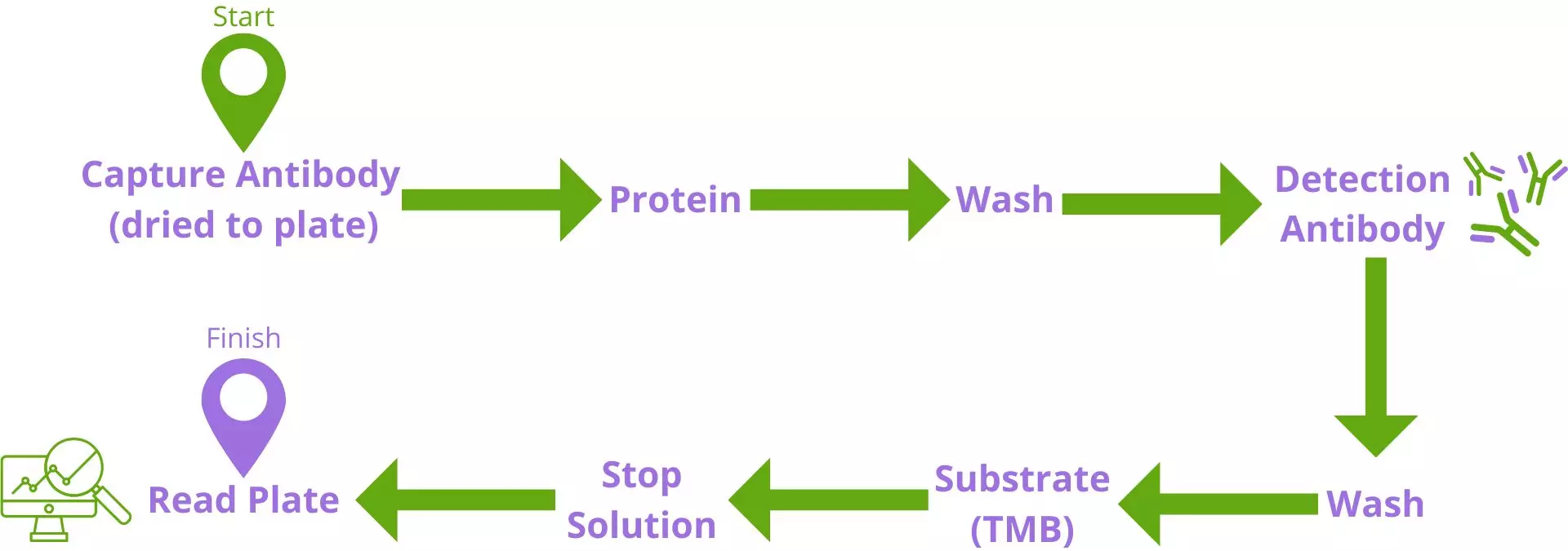
Standard Sandwich ELISA Flow Chart: Capture → Sample Addition → Wash → Detection → Wash → Substrate → Stop → Read.
2. Step-by-Step Assay Guide
Follow the typical sequence of operations when running a standard sandwich ELISA:
Pre-Coated Plate Preparation
The microplate is provided pre-coated with a target-specific capture (primary) antibody and pre-blocked to prevent non-specific binding.
Sample and Standard Addition
Test samples and prepared standard curve dilutions are added to designated wells, allowing target analytes to bind the immobilized capture antibody.
Primary Wash Cycle
The plate is thoroughly washed using wash buffer to remove unbound proteins and matrix components from the wells.
Detection Antibody Addition
A conjugated detection antibody (biotinylated or HRP-linked) is added to bind a distinct, non-competing epitope on the captured target protein.
Secondary Wash Cycle
A second wash step removes unbound detection reagents, minimizing background signal and preventing false-positive results.
Substrate Development
Chromogenic substrate (such as TMB) is added. The enzyme-substrate reaction produces a color change directly proportional to the amount of bound target antigen.
Stop Solution Addition
An acidic stop solution (commonly dilute HCl or H2SO4) is added according to manufacturer timing to halt color development.
Microplate Measurement
Absorbance (optical density) is measured at the specified wavelength (typically 450 nm) using a calibrated microplate reader.
3. Optimization Tips & Tricks
At Biorbyt, our technical team maintains extensive expertise in immunoassay development and troubleshooting. To help you avoid common benchwork pitfalls and ensure high assay reproducibility, we have compiled a detailed, free reference guide.
Access our full guide on optimizing wash steps, avoiding edge effects, preventing substrate contamination, and fitting standard curves:
4. Explore Biorbyt's ELISA Catalog
Biorbyt offers an exhaustive catalog of over 60,000 ELISA kits validated across human, mouse, rat, and exotic species models.
Find Your Target ELISA Kit
Search our complete inventory of target-specific sandwich, competitive, and quick 90-minute ELISA kits.