
You have no items in your shopping cart.

Immunology & Recombinant Technology
Monoclonal Antibodies: History, Structure & Uses
Exploring hybridoma production, recombinant phage display, and fragment cleavage for specialized research applications.
Monoclonal antibodies (mAbs) represent one of the most vital diagnostic and therapeutic tools in modern biological research. For over four decades, these monovalent reagents have enabled precise target recognition by binding specifically to a single epitope on a given antigen.
Because every monoclonal antibody in a lot originates from a single ancestral B-lymphocyte clone, they provide exceptional specificity, low background noise, and unparalleled lot-to-lot consistency compared to polyclonal mixtures.
Single-Epitope Specificity
Monoclonal antibodies bind exclusively to one unique antigenic site. This uniform binding capacity makes them ideal for quantitative assays, immunohistochemistry, flow cytometry, and targeted biotherapeutics.
1. History & Hybridoma Production
The foundational breakthrough in monoclonal antibody generation occurred in 1975, when Georges Köhler and César Milstein developed the hybridoma technique in mice—an achievement that earned them the Nobel Prize in Physiology or Medicine in 1984.
Köhler and Milstein realized that while antibody-producing B-cells harvested from an immunized mouse spleen yield highly specific antibodies, they have a limited lifespan in culture. To overcome this limitation, splenic B-cells are fused with immortal myeloma (cancer) cells using polyethylene glycol (PEG) or electroporation, generating immortalized hybrid cells termed hybridomas.
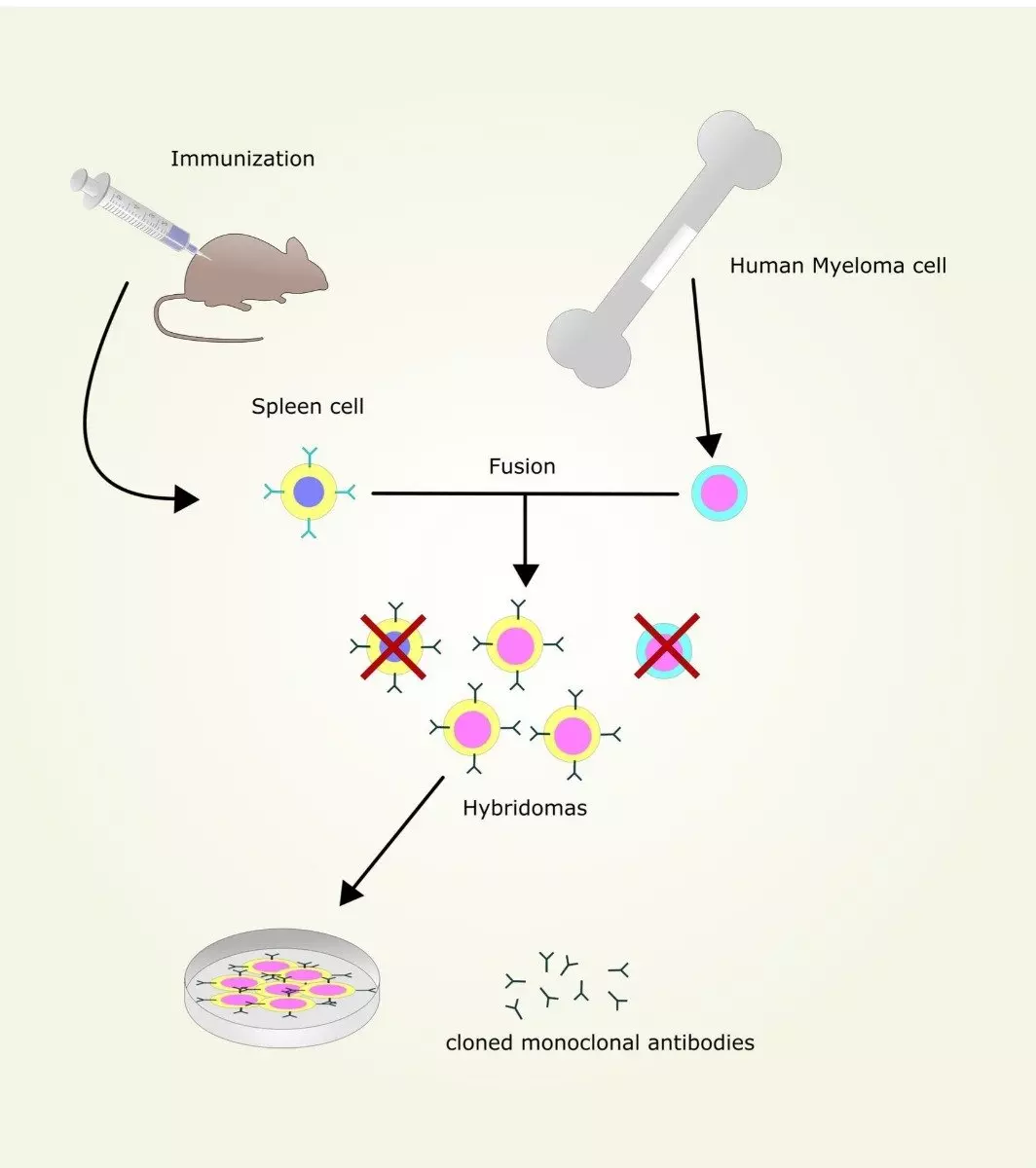
The Classical Hybridoma Production Workflow: Mouse Immunization → Spleen B-Cell Harvest → Myeloma Fusion → HAT Selection → Monoclonal Screening.
Clonal B-cells are derived from memory B-lymphocytes, meaning that every daughter cell within a selected hybridoma clone produces the exact same immunoglobulin sequence.
2. Recombinant Production & Modern Applications
While traditional hybridomas remain widely used, modern antibody engineering has introduced advanced in vitro recombinant production methods:
- Phage Display Screening: Recombinant antibody variable domains (scFv or Fab fragments) are fused to bacteriophage coat proteins, allowing vast synthetic libraries to be screened for high antigen affinity without requiring ongoing animal immunization.
- Recombinant Cell Line Expression: Once variable domain sequences are identified, they are cloned into mammalian expression vectors (e.g., CHO or HEK293 cells). This allows species constant regions (Fc) to be customized (humanized, chimeric, or mouse Fc) for specific experimental or clinical needs.
- Guaranteed Clone Stability: Recombinant cloning eliminates the risk of genetic drift, loss of expression, or hybridoma cell line death over extended culture periods.
- Unmatched Batch-to-Batch Consistency: Recombinant monoclonal production ensures absolute sequence identity across every manufacturing lot.
3. Antibody Cleavage & Engineered Fragments
For specific research applications, full-length immunoglobulins can be enzymatically cleaved to yield smaller functional fragments with distinct biochemical properties:
- Fab & F(ab')2 Fragments: Enzymatic digestion using papain or pepsin cleaves the constant region (Fc domain) above or below the flexible hinge region, producing monovalent Fab or divalent F(ab')2 antigen-binding fragments.
- Eliminating Fc Receptor Background: Because the Fc domain naturally binds cellular Fc receptors (FcγR on macrophages, monocytes, and B-cells), removing the Fc region drastically reduces non-specific background binding.
- Flow Cytometry & Tissue Penetration: Cleaved Fab/F(ab')2 fragments are especially advantageous in flow cytometry, cell sorting, and deep tissue imaging where non-specific Fc interaction or large molecular size hinders performance.
Looking for Validated Monoclonal Antibodies?
Biorbyt offers an extensive catalog of target-specific monoclonal and recombinant antibodies validated across WB, IHC, IF, and Flow Cytometry.
Search Monoclonal Catalog