Cart summary

You have no items in your shopping cart.

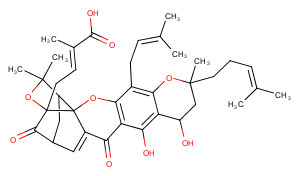
Neogambogic acid

SKU: orb1301550

Description

Neogambogic acid, a bioactive compound derived from Garcinia, exhibits anticancer properties by inhibiting the proliferation of solid tumor cells, including the human breast cancer MCF-7 line. Its activity has been demonstrated in vitro, supporting its application in oncology research for studying apoptosis and tumor growth mechanisms.

Research Area

Cell Biology, Infectious Disease & Virology

Images & Validation

Key Properties

CAS Number93772-31-7
MW646.77
Purity99.38% (May vary between batches)
FormulaC38H46O9
SMILESC(/C=C(\C(O)=O)/C)[C@@]12[C@]34C(C(=O)C=5C(O3)=C(CC=C(C)C)C6=C(C5O)C(O)C[C@](CCC=C(C)C)(C)O6)=CC(C1=O)(C[C@]4(C(C)(C)O2)[H])[H]
TargetAntibacterial,Apoptosis
SolubilityDMSO:6.47 mg/mL (10 mM)

Bioactivity

In Vivo
Neo-gambogic acid(NGA) dose of ≤0.4 μg/ml had no significant effect on the proliferation of mouse BMMs in vitro (P>0.05); concentrations of between 0.1-0.4 μg/ml significantly inhibited RANKL-induced osteoclastogenesis (P<0.01) in a dose-dependent manner. Compared with the control group, NGA significantly reduced RANKL-induced bone resorption in vitro (P <0.01), and downregulated the expression of osteoclast-related mRNAs of TRAP, CTR, CTSK, and NFATc1. NGA suppressed the activation of JNK but not the p38 signaling pathway and significantly reduced NF-κB p65 phosphorylation and the nuclear transport of NF-κB molecules, which inhibited NFATc1 expression. CONCLUSIONS NGA suppressed RANKL-induced osteoclastogenesis by inhibiting the JNK and NF-κB pathways in mouse BMMs in vitro and reduced osteoclastic bone resorption.
In Vitro
Neo-gambogic acid(NGA) significantly reduced the proliferation of MCF-7 cells in a dose-dependent manner. NGA could increase the expression of the apoptosis-related proteins FasL, caspase-3, caspase-8, caspase-9, and Bax and decrease the expression of anti-apoptotic protein Bcl-2 accompanied by the mitochondrial transmembrane damage. The antiproliferative effect of NGA on MCF-7 cells is due to the G(0)/G(1) arrest, increased apoptosis and activation of Fas/FasL and cytochrome C pathway.
Cell Research
MCF-7 cells (5* 10^4 ) were seeded into 96-well plates.Four hours later, 10 ul NGA in DMSO was added into the wells at various concentrations (0.5-24 ug/ml) and 0.1% DMSO was set as a negative control. After 72 h, 50 ul MTT was added and cells were incubated for another 4 h. Then, media was removed and 150 ul DMSO was added and the plates were placed on a shaking table at 150 rpm for 10 min. Optical density (OD) was measured at 490 nm. The experiment was repeated thrice and the rate of cell inhibition was calculated using the following formula: inhibition rate [1-(OD test/ OD negative control)]*100%.
Animal Research
Primary mouse BMMs were cultured with increasing concentrations of NGA. Real-time polymerase chain reaction was used to study the expression of mRNAs corresponding to gene products specific to receptor activator of NF-κB ligand (RANKL)-induced osteoclast differentiation, including tartrate-resistant acid phosphatase (TRAP), calcitonin receptor (CTR), cathepsin K (CTSK), and nuclear factor of activated T cells c1 (NFATc1). A cell counting kit-8 assay was used to evaluate cell proliferation. Western blotting and confocal immunofluorescence microscopy were used to investigate the signaling pathways. A bone resorption model was used to quantify bone resorption.

Storage & Handling

Storagekeep away from direct sunlight | Powder: -20°C for 3 years | In solvent: -80°C for 1 year | Shipping with blue ice/Shipping at ambient temperature.
Expiration Date12 months from date of receipt.
DisclaimerFor research use only

Alternative Names

cells, breast, cancer, Apoptosis, arrest, Bacterial, MCF-7, Inhibitor, inhibit, MRSA, Neogambogic acid, neo-gambogic acid, tummor, proliferation

Similar Products

  • Neogambogic acid (Standard) [orb3140781]

    93772-31-7

    646.77

    C38H46O9

    10 mg
  • neo-gambogic acid [orb1220670]

    >98% (HPLC)

    93772-31-7

    646.8

    C38H46O9?

    25 mg, 50 mg, 100 mg, 1 g, 500 mg, 200 mg, 5 mg, 10 mg
Quality Guarantee

Quality Guarantee

Explore bioreagents carefree to elevate your research. All our products are rigorously tested for performance. If a product does not perform as described on its datasheet, our scientific support team will provide expert troubleshooting, a prompt replacement, or a refund. For full details, please see our Terms & Conditions and Buying Guide. Contact us at support@biorbyt.com.

Neogambogic acid

Neogambogic acid

Key Properties

No computed properties available.

Documents Download

Datasheet
Product Information
Download
MSDS
Safety Data Sheet
Download

Request a Document

Protocol Information

Neogambogic acid (orb1301550)

  • Star
  • Star
  • Star
  • Star
  • Star
  • 0.0
Based on 0 reviews

Participating in our Biorbyt product reviews program enables you to support fellow scientists by sharing your firsthand experience with our products.

Login to Submit a Review

No reviews yet

Step 1: Enter information below

(Recommended: An additional animal making an allowance for loss during the experiment)

Step 2: Enter the in vivo formulation

(This is only the calculator, not formulation. Please contact us first if there is no in vivo formulation at the solubility Section.)

% DMSO +
%+
% Tween 80 +
%

Available Sizes

Select a size below

1 mg
$ 90.00
5 mg
$ 140.00
10 mg
$ 190.00
25 mg
$ 290.00
50 mg
$ 410.00
100 mg
$ 590.00
DispatchUsually dispatched within 3-5 working days
Bulk Enquiry