Cart summary

You have no items in your shopping cart.

Phospho-PKC (pan) (gamma Thr514) (PF4) rabbit mAb Antibody

SKU: orb1946008

Description

Protein Kinase (PKC) is a 12 member family of serine/threonine kinases termed conventional or classical(a b,g), novel (d ,e ,andq ), atypical (z ,l) and PKN and PKC-related (PKN1, PKN2 and PKN3) playing significant role in several signaling processes involved in physiological and pathological setting (1). PKC activation translates into gene expression modulation, cell division, migration, proliferation, differentiation, and cell survival and apoptosis (2).PKC members are classified based on their distinct cofactor requirements and the extent of homology between their regulatory elements (3,4). PKCalpha,beta I,beta II, andgamma constitute the conventional PKC isoforms, characterized by the presence of two cysteine-rich zinc finger domains, C1a and C1b (5,6) which bind to diacylglycerol (DAG) and phosphatidylserine (PS) (7). In addition, PKC contains a C2 domain, responsible for binding anionic phospholipids like phosphatidylinositol bisphosphate (PIP2) in a Ca2+-dependent manner (8,9). The atypical PKC, PKCzandlshare ATP-binding domain and the catalytic domain with PKC. They contain a single C1 domain that lacks residues necessary for binding DAG (10). Association of PKCg to the membrane enables a conformation that permits phosphoinositide-dependent protein kinase1 (PDK-1) (11) to bind and phosphorylate a site in the activation loop, Thr514. (12,13). Thr514 phosphorylation leads to a conformation change enabling phosphorylation of at two carboxyl-terminal sites namely, the turn motif and hydrophobic motif, as a result of which the fully phosphorylated conventional PKC is released from the membrane, and positioned in the cytoplasm as an inactive form (14,15). Binding of Ca 2+induces low-affinity interaction with the membrane, whereas the membrane imbedded cofactor DAG to PKC results in high-affinity interaction of PKC with the membrane (16).

Images & Validation

Tested ApplicationsFC, WB
Dilution range1µg/mL - 0.001µg/mL. It is recommended that the reagent be titrated for optimal performance for each application. See product image legends for additional information.
ReactivityHuman, Mouse, Rat

Key Properties

HostRabbit
ClonalityMonoclonal
IsotypeRabbit IgG1k
Clone No.PKCgT514-PF4
ImmunogenA synthetic phospho-peptide corresponding to residues surrounding Thr514 of human phospho PKCg
PurificationProtein A+G
ConjugationUnconjugated

Storage & Handling

StorageMaintain refrigerated at 2-8°C for up to 2 weeks. For long term storage store at -20°C in small aliquots to prevent freeze-thaw cycles.
Form/AppearanceLiquid
Buffer/Preservatives1X PBS, 0.02% NaN3, 50% Glycerol, 0.1% rAlbumin
Concentration0.5 mg/mL
DisclaimerFor research use only

Alternative Names

Protein kinase C gamma type, PRKCG, PKCG

Similar Products

Quality Guarantee

Quality Guarantee

Explore bioreagents carefree to elevate your research. All our products are rigorously tested for performance. If a product does not perform as described on its datasheet, our scientific support team will provide expert troubleshooting, a prompt replacement, or a refund. For full details, please see our Terms & Conditions and Buying Guide. Contact us at support@biorbyt.com.

Phospho-PKC (pan) (gamma Thr514) (PF4) rabbit mAb Antibody

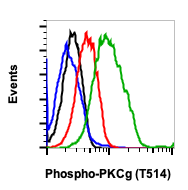
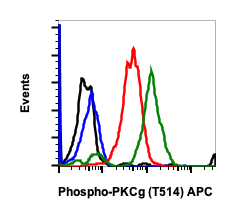
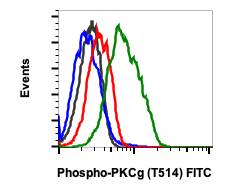
Flow cytometric analysis of HT1080 cells treated with staurosporine (red) or untreated (green) using Phospho-PKCg (Thr514) (PF4) Rabbit mAb. at 0.05 ug/mL, PKCgT514-PF4 #orb1946008, or concentration-matched Rabbit (G9) mAb IgG Isotype Control #orb1946241 for cells treated with staurosporine (black) or untreated (blue). Flow cytometric analysis of HT1080 cells, treated with staurosporine and stained with the secondary antibody only as negative control (blue) or treated with staurosporine (red) or untreated (green) using Phospho-PKC (pan) (gamma Thr514) antibody PKCgT514-PF4 at 0.05 μg/mL. Cat. #orb1946008.

Phospho-PKC (pan) (gamma Thr514) (PF4) rabbit mAb Antibody

Flow cytometric analysis of Jurkat cells, treated with K252a and stained with the secondary antibody only negative control (blue) or treated with K252a (red) or untreated (green) using Phospho-PKC (pan) (gamma Thr514) antibody PKCgT514-PF4 at 0.1 μg/mL. Cat. #orb1946008.

Phospho-PKC (pan) (gamma Thr514) (PF4) rabbit mAb Antibody

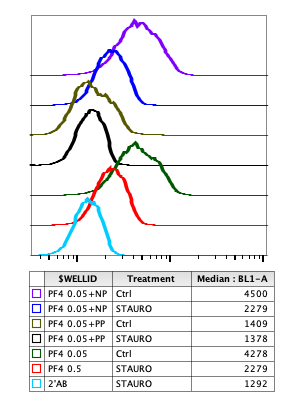
Peptide blocking flow cytometric analysis of HT1080 cells secondary antibody only negative control (light blue) or untreated (red) or treated with staurosporine (green) or untreated and blocked with phospho-peptide (black) or treated with staurosporine and blocked with phospho peptide (gold) or untreated and blocked with non-phospho peptide (dark blue) or treated with staurosporine and blocked with non-phospho peptide (purple) using Phospho-PKCg (Thr514) antibody PKCGT514-PF4 at 0.05 μg/mL. Cat. #orb1946008.

Phospho-PKC (pan) (gamma Thr514) (PF4) rabbit mAb Antibody

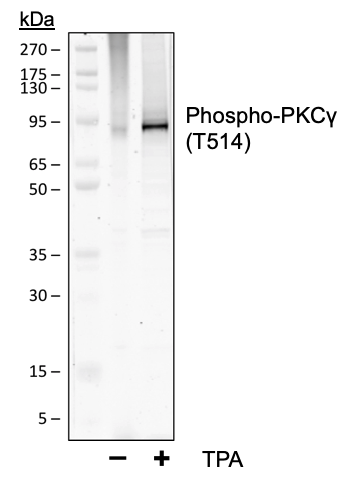
Western blot analysis of NIH3T3 cell extract untreated or treated with TPA using Phospho-PKC (pan) (gamma Thr514) antibody PKCgT514-PF4 at 0.05 ug/mL. Cat. #orb1946008.

Phospho-PKC (pan) (gamma Thr514) (PF4) rabbit mAb Antibody

Western blot analysis of C6 cell extract untreated or treated with staurosporine using Phospho-PKC (pan) gamma (Thr514) antibody PKCgT514-PF4 at 0.1 ug/mL. Cat. #orb1946008.

UniProt Details

No UniProt data available

Documents Download

Datasheet
Product Information
Download

Request a Document

Protocol Information

WB
Western Blot (IB, immunoblot)
View Protocol
FC
Flow Cytometry
View Protocol

Phospho-PKC (pan) (gamma Thr514) (PF4) rabbit mAb Antibody (orb1946008)

  • Star
  • Star
  • Star
  • Star
  • Star
  • 0.0
Based on 0 reviews

Participating in our Biorbyt product reviews program enables you to support fellow scientists by sharing your firsthand experience with our products.

Login to Submit a Review

No reviews yet

Available Sizes

Select a size below

20 μl
$ 370.00
200 μl
$ 910.00
DispatchUsually dispatched within 5-10 working days
Bulk Enquiry